
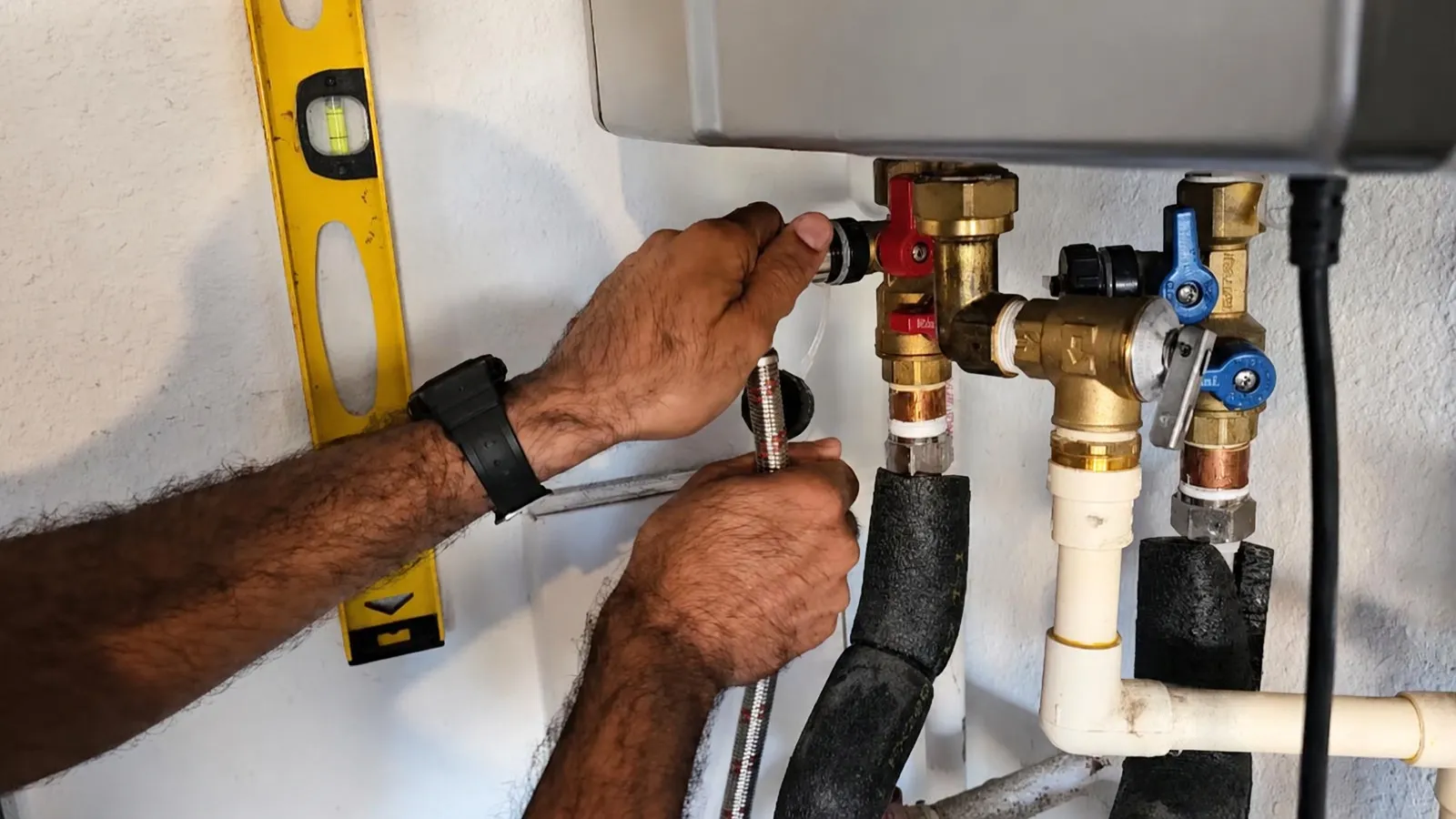
How a tankless water heater works
When a hot tap opens, flow sensors fire a burner or heating element and heat the water as it passes through a heat exchanger. There is no tank to heat and hold, so standby loss is low and the supply does not run out until you exceed the unit's flow limit.
Tankless units fit homes with high or irregular demand, and they free floor space. They are not right for every house, because the gas line, the vent and the water quality all affect how well they run.
Is your home a good fit?
| Check | Good sign | Possible problem |
|---|---|---|
| Gas line size | Large enough for the unit's input | Small line needs upsizing |
| Vent | Direct vent can go through a wall | Long runs or old chimneys need changes |
| Hot water use | Several fixtures at once | A single small bathroom may not benefit |
| Water hardness | Treated or soft water | Hard water needs regular flushing or a softener |
Your plumber checks each item on site.
How we install or service a tankless unit
Assess
We check gas capacity, venting, water pressure and the wall location.
Install
We mount the unit, connect water and gas, run the vent and set a condensate drain.
Commission
We test flow, temperature rise and combustion, and set the controls.
Maintain
We flush the heat exchanger with descaling solution at intervals that match your water.
Want a tankless quote?
Call and we will book a visit that fits your schedule.
What a tankless install costs and what changes it
You hear a clear price before work starts. Tankless costs more up front than a tank because of the gas, vent and electrical work.
The factors:
Tankless units are not an insurance matter unless a failure caused damage. Keep your install records and flush schedule.
Tankless in Massillon: water quality matters
Massillon's public water comes mostly from Aqua Ohio's Massillon Division wells in the Tuscarawas Valley. We do not quote a hardness number here because it changes. Ask the utility or test your tap. If the water is hard, scale builds up in a tankless heat exchanger faster than in a tank, so a softener or filter and an annual flush protect your investment.
A tankless unit that shows an error code or runs cold often needs a flush, a vent check or a new sensor. We service units we did not install, and we explain the repair before we start.
Running a tankless heater well
Tankless units reward a little attention. Keep the area around the unit clear, check that the vent terminal is free of snow and debris, and listen for new noises. A unit that cycles on and off at low flow may need a different setting, and a unit that cuts out when two showers run may be undersized.
Flush the heat exchanger on the schedule your plumber suggests, and keep the service records. If the water gets cold at one tap and stays hot at others, the fault may be a mixing valve or a crossed line, and a short visit sorts it out.
A tankless install follows the maker's instructions for gas sizing, venting and condensate, and the standards in the Ohio Plumbing Code, OAC Chapter 4101:3.
Tankless water heater questions
Many last about twenty years with maintenance, though water quality changes that. Regular flushing matters.
Not quite. You run out if demand exceeds the unit's flow limit, but that is far less likely than draining a tank.
Yes. Annual flushing and a vent and filter check keep them running.
Usually yes. Sensors, igniters and scale buildup are common repairs. See water heater repair too.
You hear a clear price before work starts. The unit, gas, vent, water treatment and permits all matter.